

South Texas
Safe Water Project
A partnership between Methodist Healthcare Ministries of South Texas and Texas A&M University School of Public Health.
Safe Water Starts Here
Turning on the tap shouldn’t feel like a gamble, but that’s the reality for many families living in South Texas colonias. Generations of inadequate infrastructure and unsafe drinking water have created serious health challenges for these underserved communities.
Learn how the South Texas Water Project is combining research, community partnerships and advocacy to improve water quality and ensure every family has access to safe drinking water.
Download the full REPORT
Over the span of 2.5 years, Methodist Healthcare Ministries and Texas A&M University partnered with residents in the Progreso and Alamo colonias to investigate the community’s water quality and environmental concerns, and to better understand how drinking water impacts health. The study revealed contaminants, including uranium, arsenic, nickel, and lead, in local water samples and uncovered elevated rates of chronic health conditions. The results gave us valuable insight that will help shape future efforts and improve access to safe drinking water.
Download the full report to explore the findings, methodology, and recommendations for improving environmental and public health across Texas.


The South Texas Safe Water Project, a partnership between Methodist Healthcare Ministries of South Texas, Inc. (MHM) and Texas A&M University School of Public Health, addressed critical environmental and public health issues in colonia communities along the US-Mexico border.
Key Findings
Uranium, nickel, and arsenic were detected in 100% of potable water samples, posing severe health risks, including cancer and developmental delays.
Despite fines imposed on water providers for EPA violations, many continued non-compliance, indicating the need for stronger enforcement mechanisms and consistent monitoring.
Arsenic was detected in all participants’ urine and toenail samples, indicating acute and long-term exposure.
One-third also had detoxification-related vitamin deficiencies, suggesting increased vulnerability to environmental exposure. After implementing water filters, urinary arsenic levels significantly declined, demonstrating the effectiveness of primary interventions and guiding future strategies.
A comprehensive health assessment using the Short Form 12-Item (version 2) Health Survey revealed significant declines in general physical health scores among residents, underscoring the broader health impacts of chronic environmental exposures.
Health risks were particularly acute for children and pregnant women, highlighting the urgency of targeted public health interventions.
The project was driven by a Community-Based Participatory Research (CBPR) model, emphasizing collaboration with local stakeholders.
Three Community Advisory Boards (CABs), involving Promotoras, nonprofit leaders, and residents, were pivotal in shaping research priorities and disseminating findings. This approach resulted in strong community trust and high participation rates, including a 96.2% survey completion rate and over 80% biomarker sample collection.
THE SOUTH TEXAS SAFE WATER PROJECT, a collaborative initiative between Methodist Healthcare Ministries of South Texas (MHM) and the Texas A&M University School of Public Health (TAMU SPH), was launched to address critical public health and environmental challenges facing in South Texas colonias, some of the most underserved communities in the United States.
- Identify and engage two colonias in Hidalgo County
- Evaluate drinking water quality for heavy metal contamination
- Collect biomarker data for exposure assessment
- Conduct a comprehensive community health survey
- Develop a citizen science program for local high school students
- Host a policy workshop with key stakeholders


Community Engagement Approach
The engagement strategy for the project was built on the principles of Community-Based Participatory Research (CBPR), prioritizing shared ownership, collaboration, and respect for local expertise. This philosophy emphasized creating a reciprocal relationship with the community, valuing their knowledge, and involving them directly in shaping the research process. By integrating the trusted voices of Promotoras, Community Advisory Boards (CABs), and several local nonprofit organizations, the approach ensured culturally relevant engagement and deepened the connection between the research team and the residents.
Impact on Research Outcomes and Data Collection
The community engagement approach significantly enhanced the quality and relevance of the research outcomes. By involving CABs, Promotoras, and nonprofit partners throughout the project, the team was able to gather more accurate, context-specific data that directly reflected the community’s needs and concerns.
Data Analysis Techniques

Metallomic Profiling in Toenails

Urinary Arsenic Analysis and Intervention

Nutritional Status and Arsenic Metabolism
Data Collection Methods
Phase 1
Community-based
Participatory Research

Participant Recruitment Administration
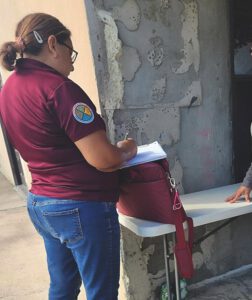
Survey Administration

Onsite Water Testing & Additional Water Sample

Intervention Items & Stipends
Phase 2
Community-based
Participatory Research


Collection of Biomarker Samples (Urine, Toenail, & Dry Blood)
Baseline & Follow-Up Dietary Consumption Surveys

Participant Certificate of Acknowledgment & Stipends
Participant Engagement & Retention


BIOMONITORING — ARESENIC
These results highlight the findings from biomarker assessments, revealing what was present within participants’ bodies.

Notably, there was a significant reduction in the number of individuals in the high-risk category following the implementation of filtered water provided to participants.

Notably, there was a significant reduction in the number of individuals in the high-risk category following the implementation of filtered water provided to participants.
Perceived Health Status
The results from the mental and physical health assessment reveal a statistically significant reduction in physical health compared to county and state averages.


PROJECT EXPANSION
Expanding the program across additional counties in South Texas is a critical next step to address the region’s diverse environmental and public health challenges.